Skip to content

Supply-chain rules map

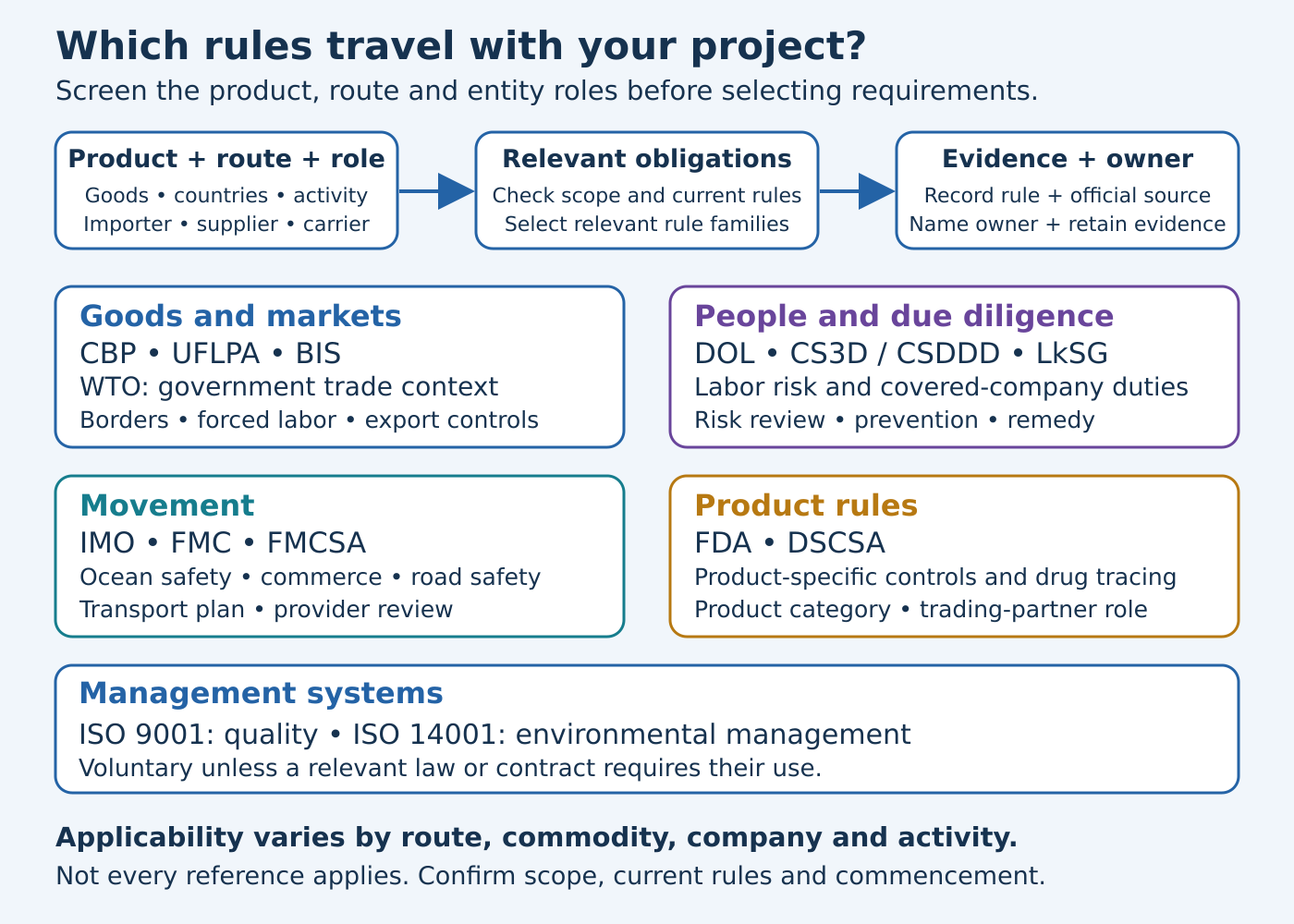
Use these references to spot obligations and name who verifies them. They are a starting point, not legal advice.

Supply-chain rules map grouping authorities by goods and markets, movement, people and due diligence, product rules and management systems

Goods and markets

CBP · Weeks 2, 4, 5, 7, 12

U.S. Customs and Border Protection

Jurisdiction: United States; goods entering U.S. customs territory

Facilitates legitimate international trade and enforces U.S. customs and import requirements at the border.

For U.S. imports, identify importer responsibilities, goods, origin, customs classification, valuation, admissibility and applicable partner-agency requirements.

PM question: Who owns the import records, customs review and release dependency before we promise a delivery date?

Official source

WTO · Weeks 2, 3, 5, 7, 10

World Trade Organization

Jurisdiction: International; agreements between member governments

Provides the framework for trade agreements, negotiations, dispute settlement and monitoring of member governments' trade policies.

Use to understand country-level trade commitments and policy context. Business import filings, product admissibility and shipment clearance follow the relevant national authorities' rules.

PM question: Which trade-policy assumptions could change our sourcing cost, border lead time or market access?

Official source

UFLPA · Weeks 2, 5, 7, 10, 12

Uyghur Forced Labor Prevention Act

Jurisdiction: United States; import restrictions based on upstream production and listed entities

CBP applies a rebuttable presumption that covered goods were made with forced labor and are prohibited from U.S. entry under 19 U.S.C. 1307.

U.S. imports mined, produced or manufactured wholly or partly in Xinjiang, or by an entity on the UFLPA Entity List; upstream inputs matter.

PM question: Can we trace the material's production chain and document the review before committing to a supplier or shipment?

Official source

BIS / EAR · Weeks 2, 3, 5, 7, 10, 12

U.S. Bureau of Industry and Security

Jurisdiction: United States export controls; may reach overseas transactions involving items subject to the EAR

Administers export controls under the Export Administration Regulations for covered items and activities, including relevant exports, reexports and transfers in-country.

First determine EAR jurisdiction; review item classification, destination, end-user, end-use and relevant activities. Some foreign-made items and technology releases can be covered.

PM question: Who confirms jurisdiction, screening and any required authorization before goods, software or technology move?

Official source
Movement

IMO · Weeks 2, 4, 5, 7, 10

International Maritime Organization

Jurisdiction: International shipping; implementation by states party to applicable instruments

Develops international maritime safety, security and environmental rules, including SOLAS, MARPOL and the IMDG Code.

Relevant to ocean transport, vessel and port requirements, cargo safety and dangerous goods. Flag states enforce ship compliance; port states can inspect foreign ships under applicable conventions.

PM question: Which cargo classification, packaging, documentation or vessel requirements must be confirmed before we promise an ocean-shipping date?

Official source

FMC · Weeks 2, 4, 5, 7, 8

Federal Maritime Commission

Jurisdiction: United States; U.S. international ocean transportation system

Regulates U.S. international ocean transportation, including relevant carrier, marine-terminal and ocean-intermediary practices, to promote competition and protect the shipping public.

Relevant when the project uses U.S. international ocean freight or regulated ocean-transportation intermediaries; review contracts, rates, charges, licensing and dispute pathways as applicable.

PM question: Have we assigned ownership for ocean-freight contract terms, charges and any dispute or escalation?

Official source

FMCSA · Weeks 4, 5, 7, 11

Federal Motor Carrier Safety Administration

Jurisdiction: United States; covered commercial motor-vehicle operations

Promotes commercial motor-vehicle safety through applicable driver, carrier, vehicle and operating requirements, including hours of service.

Applicability depends on vehicle and operation criteria, including interstate commerce, passengers, hazardous materials and for-hire status. Specific exceptions and exemptions require review.

PM question: Does our transport plan account for qualified carriers, safe operating limits and realistic driver schedules?

Official source

People and due diligence

DOL / ILAB · Weeks 2, 5, 7, 8, 11

U.S. Department of Labor

Jurisdiction: United States labor administration; ILAB resources address international labor risks

Administers labor responsibilities; ILAB supplies country-and-goods research that helps organizations assess child-labor and forced-labor risk in supply chains.

Use ILAB research in supplier risk assessment. Assess applicable domestic labor duties separately; inclusion on the ILAB goods list is not itself an import ban.

PM question: What labor-risk evidence will inform supplier selection, follow-up actions and the person accountable for review?

Official source

CS3D / CSDDD · Weeks 2, 3, 5, 7, 10, 11

EU Corporate Sustainability Due Diligence Directive

Jurisdiction: European Union; implementation through member-state law

Requires covered companies to identify and address human-rights and environmental impacts in operations, subsidiaries and chains of activities.

Very large EU and non-EU companies meeting amended scope tests; certain franchise or licensing arrangements also qualify. Smaller business partners can be indirectly affected, with protections limiting information requests.

PM question: Has the compliance lead confirmed company scope, implementation dates, priority impacts and the evidence our supplier-onboarding project must retain?

Official source

LkSG · Weeks 2, 3, 5, 7, 10, 11

German Supply Chain Due Diligence Act

Jurisdiction: Germany; oversight by BAFA

Establishes risk-based human-rights and specified environmental due diligence, including responsibility, risk analysis, prevention, remedy, complaints and documentation.

Covered businesses with a German presence meeting statutory employee criteria. Suppliers may face information or contractual requests even when outside direct statutory scope; confirm the precise company test.

PM question: Who owns supplier risk assessment, complaints, remedy and retained evidence, and which current LkSG duties apply to this organization?

Official source

Product rules

FDA · Weeks 2, 3, 6, 7, 12

Food and Drug Administration

Jurisdiction: United States; FDA-regulated product categories

Regulates specified categories including foods, human drugs, biologics, medical devices, cosmetics, veterinary products, tobacco and radiation-emitting products.

Determine the exact product category, role and activity. Product safety, labeling, manufacturing, import and tracing requirements differ; other agencies may share responsibility.

PM question: Which product-specific requirements and qualified reviewers must be included in our acceptance criteria and release plan?

Official source

DSCSA · Weeks 2, 3, 6, 7, 10, 12

Drug Supply Chain Security Act

Jurisdiction: United States; certain prescription-drug distribution and covered trading partners

Establishes electronic, interoperable package-level identification and tracing of certain prescription drugs to help secure the U.S. drug supply chain.

Apply the statutory product and trading-partner definitions; consider manufacturers, repackagers, wholesale distributors and dispensers, plus applicable exceptions, exemptions and other relevant requirements.

PM question: Who owns traceability data, partner verification and the procedure for suspect or illegitimate products?

Official source

Management systems

ISO 9001 — quality management · Weeks 2, 3, 6, 10, 11, 12

International Organization for Standardization — ISO 9001

Jurisdiction: International voluntary consensus standard; ISO is not a U.S. government agency

Provides requirements for a quality management system, supporting consistent processes, customer requirements, performance evaluation and improvement.

Organizations of any size or sector may use it. Determine whether adoption or certification is required by a specific contract, customer or applicable law.

PM question: Which process controls, evidence and acceptance criteria connect the project to the organization's quality management system?

Official source

ISO 14001 — environmental management · Weeks 2, 3, 5, 7, 11, 12

International Organization for Standardization — ISO 14001

Jurisdiction: International voluntary consensus standard; ISO is not a U.S. government agency

Provides an environmental management system framework for managing environmental responsibilities, monitoring performance and pursuing continual improvement.

Organizations across sectors may adopt it. Determine contract, customer or legal requirements separately; adopting a standard does not replace applicable environmental obligations.

PM question: Which environmental impacts, controls, measures and ownership must appear in our project plan and handover?

Official source